Blog
What Happens When Every Transfer Gets a Receipt
The mechanics of rebuilding trust in the last mile — one handover at a time.

The first piece was about the problem: packages change hands with no record, disputes become unresolvable, and accountability dissolves at the point where two companies meet.
This one is about what we built to fix it. And why how it works matters as much as what it does.
The receipt problem
The reason handover disputes are hard to resolve is simple. No receipt exists.
If one did — a timestamped, GPS-stamped, verifiable record that two specific parties exchanged custody of a specific shipment — most disputes would close in thirty seconds. You open the record. You see who had it and when. Done.
The question is what that receipt looks like and who holds it.
A receipt held by one company is a claim. A receipt held by neither company, verifiable by both, is a fact.
That distinction is everything.
What a Trackam handover actually looks like
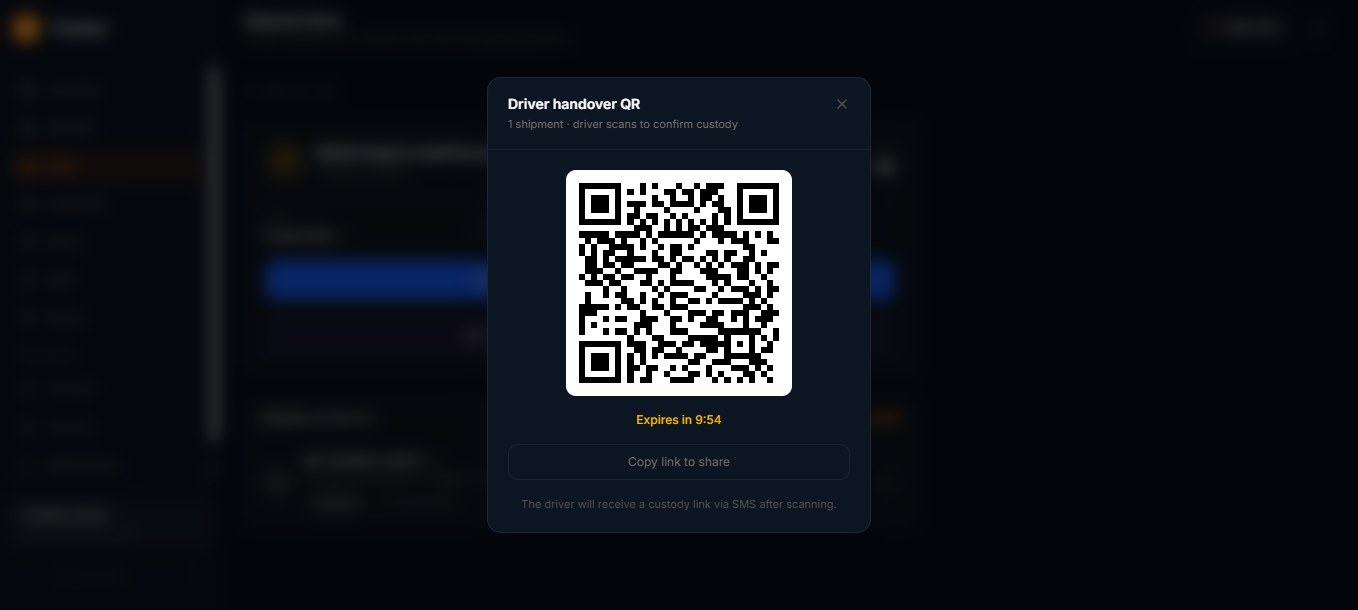
A dispatcher creates a run — a group of waybills assigned to a vehicle. When the rider arrives to collect, the dispatcher taps "Hand over to driver." A QR code appears with a 15-minute expiry.
The rider opens Trackam on their phone. They authenticated once when they onboarded, so their identity is already tied to their verified record. They scan the QR. Their screen shows twelve shipments, the route, sender names.
They tap "Accept."
At that moment, four things are recorded simultaneously:
- ✦Timestamp of the transfer
- ✦GPS coordinates of both devices
- ✦Identity of both parties, pulled from their authenticated sessions, not typed into a form
- ✦A SHA-256 hash of the waybill ID, both actor types, coordinates, and timestamp
That hash is the proof of handover. It is immutable. It cannot be edited after the fact. It lives in the custody chain of that waybill, visible to anyone authorised to view it.
Both parties have a receipt. The dispatcher's screen updates. The rider's screen updates. The record exists.
Why identity verification happens at onboarding, not at the handover
This is the detail that changes how disputes work.
In the current informal system, a rider's identity is whatever they say it is when they show up. In most formal systems, it is whatever they type into a form at the point of transfer. Both are weak. A typed name proves nothing.
In Trackam, identity is verified once, at onboarding. The rider submits a government ID and a photo. An administrator reviews and approves it. From that point forward, their verified identity flows from their authenticated session every time they accept a handover. They never have to submit ID again.
The difference is the dispute record. A proof of handover that says "Ibrahim Musa, verified NIN, received custody at 2:14pm at 6.5°N 3.4°E" is evidence. A proof that says "Ibrahim" is noise.
The cross-operator problem
The hardest version of the handover problem is not within one company. It is between companies.
When your rider hands off to a partner hub, your system stops seeing the package. The partner's system may not even know the package exists. The handover is informal because there is no shared layer for either system to write to.
This is what the Open Logistics Interconnect (OLI) solves.
Each operator runs their own Trackam instance. Their riders, their waybills, their runs — all private, on their own server. But when a handover crosses company lines, both instances record the same event through OLI. The custody chain follows the package, not the platform.
The OLI Switch sits in the middle. It does not store your business data. It sees only the handover events: who, what, when, where. Each event generates a proof hash. That hash is recorded on both operators' instances at the same time.
A waybill that moves through three different operators — as many do in hub-and-spoke networks — has a single auditable chain of custody that no single operator controls. When a dispute opens, you open the chain. Every transfer is there.
What changes for each person in the chain
For the dispatcher: you know in real time when your rider accepted custody. When something goes missing, you open the chain instead of a WhatsApp thread.
For the rider: you have a receipt for everything you touched. When a dispute opens about a delivery you made three weeks ago, you can point to the record. You are protected by proof, not left to argue from memory.
For the hub operator: every incoming and outgoing transfer is documented. Cross-operator disputes, where your partner claims you never received a package, get resolved by the chain.
For the customer: you get a public tracking URL. If you verify your identity as the receiver, you see the full name and contact details of every party who handled your package. "Out for delivery" becomes a transparent chain of events you can actually read.
For the founder or CEO: the 6pm call from the customer whose package is missing stops being unresolvable. You open the chain. You see exactly where it broke.
What this is building toward
Proof of handover is the foundation. What it enables is a logistics network where accountability travels with the package across company boundaries, where a shipment's history belongs to the shipment and not to whichever company happens to be holding it when you ask.
This is the infrastructure layer that makes reliable cross-operator logistics possible in Nigeria and across Africa. Not another platform pulling operators into its own locked ecosystem. Open infrastructure any operator can join, run on their own server, and use to build real trust with their partners.
Trackam is open source. The handover logic, the hash generation, the proof chain — all of it is readable.
If you run a logistics operation and want to see what your handover chain looks like, Install Trackam today.

Get Started
Let's Fix What's Slowing Your Organization Down
If your operations rely on spreadsheets, manual follow-ups, or disconnected tools, there's an opportunity to perform better.