Blog
The Handover Problem in Logistics (Why Packages Disappear)
Why the most dangerous moment in logistics is the one nobody records.

If you have ever sent a package and watched it disappear for three days before anyone admitted it was lost, the problem started before the delivery failed.
It started the moment the package passed from one person to another and nobody created a record of that moment.
That moment is called a handover. And it is the most structurally broken part of logistics in Nigeria.
What a handover actually is
A handover is any point where physical custody of a shipment moves from one party to another. Sounds simple. But a single package from Lagos to Abuja might pass through five or six of them.
Merchant to dispatch rider. Rider to aggregation hub. Hub to long-haul vehicle. Vehicle to Abuja sorting facility. Facility to last-mile rider. Rider to customer.
Six moments where the question "who has it right now?" either has a clear answer or doesn't.
In most Nigerian logistics operations today, it doesn't.
What actually happens at a handover
A rider arrives at a hub with fifteen packages. They hand them to whoever is at the counter. Maybe someone counts. Maybe nobody does. The rider leaves. A WhatsApp message goes out.
"Dropped off at Ogba hub. 15 packages."
That message is the receipt.
This is not carelessness. It is what happens when the tooling to do better has never existed. Nobody built a process for capturing a verifiable record of physical custody transfer between two people standing in a warehouse on a Tuesday afternoon. So everyone improvised. Phone calls. Messages. Handshakes.
None of those survive a dispute.
Where the problem concentrates
The handover problem is not random. It shows up at specific points.
Between companies. When a package crosses from your operator to a partner's hub, your system stops seeing it. Their system may not know your package exists. The package is now in a gap between two operators' worlds. No shared record. No single source of truth.
At scale. One rider handling twenty packages is manageable with informal systems. A hub processing three hundred packages a day across twelve different operators is not. WhatsApp threads collapse. Counter sign-offs disappear. The volume breaks the workaround.
At the last mile. This one is quietly the worst. "Delivered" appears in the system, but who confirmed it? The rider. The same rider whose incentive is to mark deliveries complete. Without something independent, an OTP from the customer, a timestamp from their location, "delivered" is an assertion. It is not proof.
What this actually costs
The visible cost is the disputed package. When a customer says they never received it and the operator has no proof of delivery, the resolution process starts. Call the rider. Call the hub. Search the WhatsApp thread from three days ago. This takes time and usually ends in a refund or a write-off.
A mid-sized courier handling 500 shipments a day and disputing 20 to 30 of them is carrying real exposure daily, before you even count the staff time it takes to resolve each one.
The invisible cost is larger.
The customer who received nothing and said nothing. Did not complain. Did not shout. Just never used the service again. In a market where it costs real money to acquire customers and repeat business is the actual margin, silent churn from failed deliveries is a slow bleed that most operators do not see coming until it is too late to trace.
Then there is the rider. The one who handed fifteen packages to a hub and left with no receipt. When three of those packages go missing, they are defenceless. They know they delivered them. They cannot prove it. The dispute becomes a he-said-she-said between two people who both believe their own version of what happened. This is demoralising in ways that go beyond the specific incident. It makes an already difficult job adversarial.
And for operators trying to build cross-company partnerships, every handover that leaves no trail is a risk sitting inside the relationship. When trust breaks over a lost package with no record, it often breaks permanently.
Why it has not been fixed
The handover problem is not a technology gap. The technology for capturing a timestamp or sending an OTP is not the hard part.
The hard part is that fixing it requires two operators on two different systems to agree on a shared record of a physical event that happened between them.
Every logistics platform in existence today is built to solve one operator's problem. Your dispatch tool tracks your riders. Their warehouse system tracks their inventory. Neither system knows about the other's. When the package crosses the boundary, the shared record does not exist. There is no layer that sits between operators and creates a single version of what happened.
This is how you end up with a market full of logistics software and still no reliable answer to who has a specific package right now and when they took it.
The handover problem is not a gap inside your system. It is a gap between systems.
***
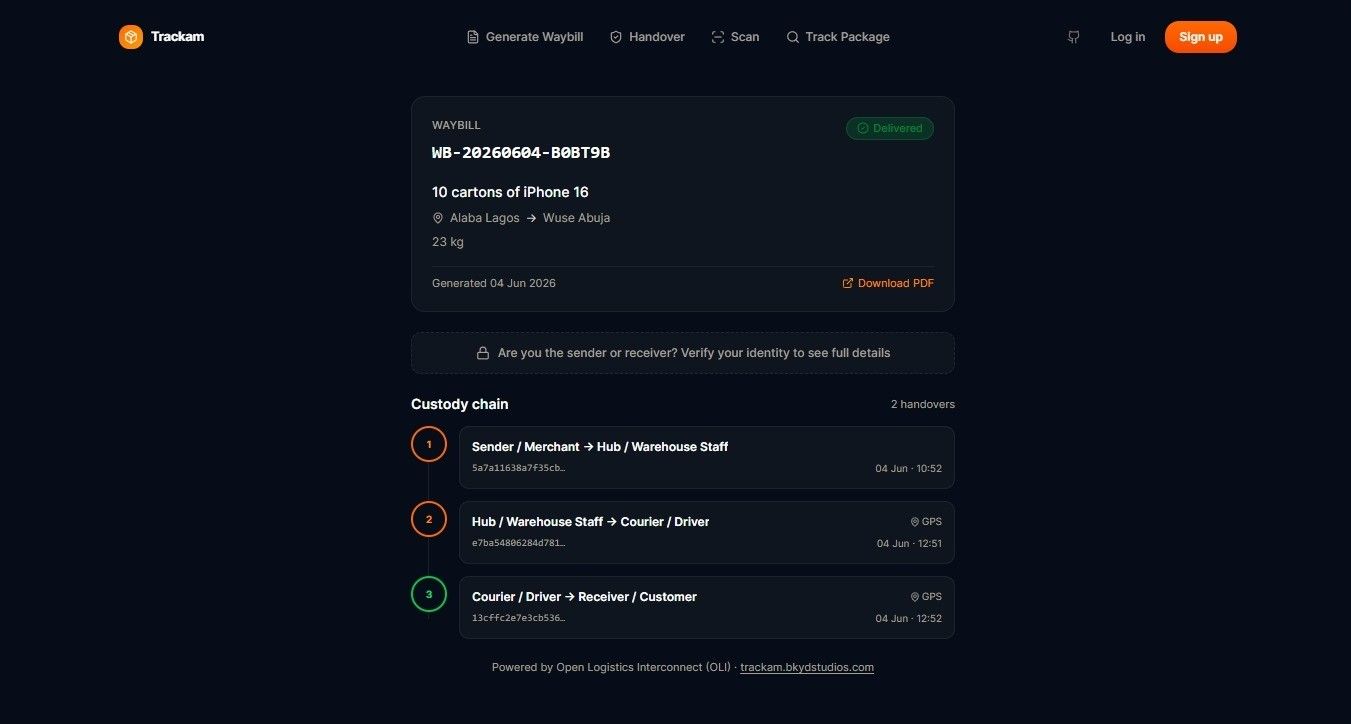
Trackam is building infrastructure for shared custody records across logistics operators. Read how it works →

Get Started
Let's Fix What's Slowing Your Organization Down
If your operations rely on spreadsheets, manual follow-ups, or disconnected tools, there's an opportunity to perform better.